Prediabetes is supposed to be the early warning. It isn't.
By the time the word shows up on a lab report, the smallest micro-organ in the body — the pancreatic islet — has been failing for years.
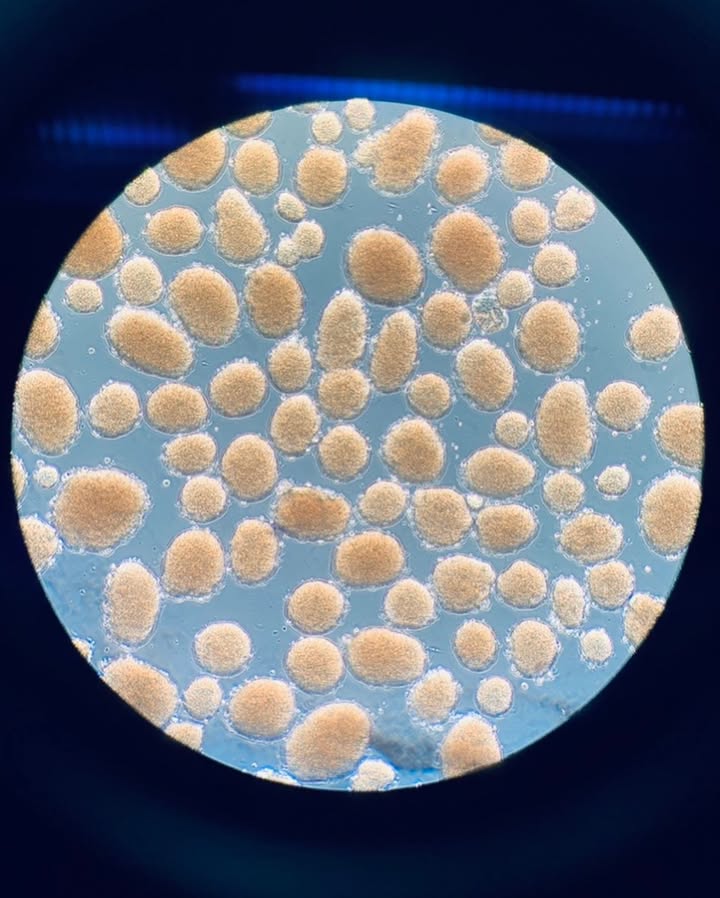
Pancreatic islets are tiny clusters scattered through the pancreas, just 1–2% of its mass, but they house the β-cells that make insulin and the α-cells that release glucagon, embedded in a microvasculature and immune-neural environment that lets them behave less like a tissue and more like a small networked organ. The failing happens quietly, measurably, and in ways no standard test currently catches. It took fifteen years across three labs, sitting with patients in clinic, and brushing the dust off decades-old literature — all on that one small organ — to arrive at this view.
The many origins of a β-cell
2010–2016 · Harvard / Joslin
When I started graduate school, a stem-cell biologist named Shinya Yamanaka had just shown that an adult cell — a piece of skin, even — could be reprogrammed back to an embryonic-like state. He'd win the Nobel Prize for it in 2012, my second year, and a generation of regenerative medicine was forming around that single result. The implication was electric: if you could turn skin into stem cells, you could turn stem cells into β-cells, and you could grow a patient their own β-cells back. My PhD work in Rohit Kulkarni's lab sat at the intersection of that promise and the underlying biology — building β-cells from iPSCs, reprogramming the pancreas's own ductal cells into an endocrine fate, and asking what holds β-cell identity together when stress pulls at it. The lab taught me what an islet is. The work taught me how flexible — and how fragile — that identity can be.
Does glucose control rescue a failing β-cell?
2019–2022 · UT Health San Antonio
For decades, the field had taken high blood sugar as the prime mover of β-cell dysfunction in type 2 diabetes — and lowering glucose as the way to restore function. The UKPDS, the landmark trial of glucose control in type 2 diabetes, had been quietly disagreeing for thirty years: glucose control reduces complications, but it does not stop the β-cell from failing. The 2024 Banting Lecture made that point its centerpiece. If not glucose, then what? In Ralph DeFronzo's group, we offered one answer: lipid-driven inflammation persists even after glucose returns to normal, and that persistent lipotoxicity is what keeps β-cells from recovering. Glucose is one pressure among several, not the cause.
β-cells don't fail alone
2022–2026 · UT Southwestern
At UT Southwestern, the question shifted from the cell to the unit — and the institution had been pointing that way for decades. Roger Unger, working in the same center where I would later join Phil Scherer's group, had run the experiment that quietly redefined the field: destroy every β-cell in a mouse, eliminating insulin entirely, then silence the α-cells. Glucose stayed normal. The implication was almost heretical at the time — diabetes is not, fundamentally, an insulin-deficiency disease. It's a disorder of the islet as a coordinated whole.
By the time I arrived at the Touchstone Diabetes Center, that framing had become foundational in research — but not in the clinic. My own training spanned both, and the gap was hard to miss. Diabetes care still revolves around lowering glucose, preserving β-cells, and restoring insulin secretion: the islet's parts, treated one at a time. β-cells don't sit alone; they live inside an islet, alongside α-cells, δ-cells, and the vasculature that knits them into a single small organ.
Diabetes is not an insulin-deficiency disease — it's a disorder of the islet as a coordinated whole.
The struggling organ
2026–present · San Diego
If the islet fails as a unit, and the unit fails before the cell, then diabetes is an organ-failure disease — and there are many ways to get there; obesity and insulin resistance are the major paths, but not the only ones. That reframing matters most for the patients who don't fit the conventional account — lean people who develop diabetes, people with obesity who never do. The glucose-and-BMI model has no clean explanation for either. The organ-failure model does: the islet behaves like a small networked organ that can fail silently, years before any standard test detects it. Making that failure detectable early — while reversal is still on the table — is my current work.
It is, strikingly, the only major chronic disease in clinical medicine without a staging system anchored on the organ's functional capacity. Kidney disease is staged by GFR. Heart failure by ejection fraction. Liver disease by synthetic function. Diabetes is staged by glucose — a downstream signal, not a measure of the organ itself. It would be like grading kidney failure by peripheral edema or heart failure by blood pressure. Both are real findings, both worth treating. But if you anchor your diagnosis on the consequence, you miss the true disease.
If you anchor your diagnosis on the consequence, you miss the true disease.
And if glucose control alone doesn't prevent that failure — as we've known for decades — then the right question for a patient shifts. Not just how do I fix my sugar? but how do I protect my organ?
The horizon
I look forward to the day researchers and academic institutions anchor their work on islet function rather than glucose alone. The day medical schools teach the functional reserve of the islet as a micro-organ. The day pharmaceutical companies build pipelines beyond glucose-lowering drugs — today, only one class (GLP-1s) is even partially anchored on protecting and restoring islet function rather than just lowering glucose. The day investors and venture capital underwrite islet-protecting technologies and pharmacotherapies. The day the American Diabetes Association and other clinical decision-makers stage diabetes by organ function, not glucose thresholds. And, most of all, the day patients walk into clinic and ask their doctors both questions, not just one.
The harder problem is that, somewhere along the way, we already left the decades-old question behind. How do we bring it back? That's the work ahead.
The thread across all four chapters is the same: a small tissue, big stakes, and a long window of time during which something can still be done. The window exists for years before any clinic visit. It is not yet measured by any test in the guidelines — not even the test that defines prediabetes. It closes silently while a patient's lab values look fine.
Closing it earlier — making it visible, measurable, actionable — is what I left medicine to keep doing.
More essays on the blog.